HIT: generating hotel investor leads in Bali from 10+ countries
HIT case study: how we attracted hotel business investors in Bali from 10+ countries
About the client and the product
HIT is an investment company developing projects in the hotel business in Bali. Its core product is investment in hotel complexes and hotel projects with returns in hard currency:
- entry from $182 000,
- returns from 23% per year in $,
- resale returns of up to 33% per year,
- passive income with guaranteed returns.
This offer is aimed at A-class audience: affluent investors looking for ways to diversify capital, protect it from inflation and keep their money in a stable currency.
OWL AGENCY's objectives
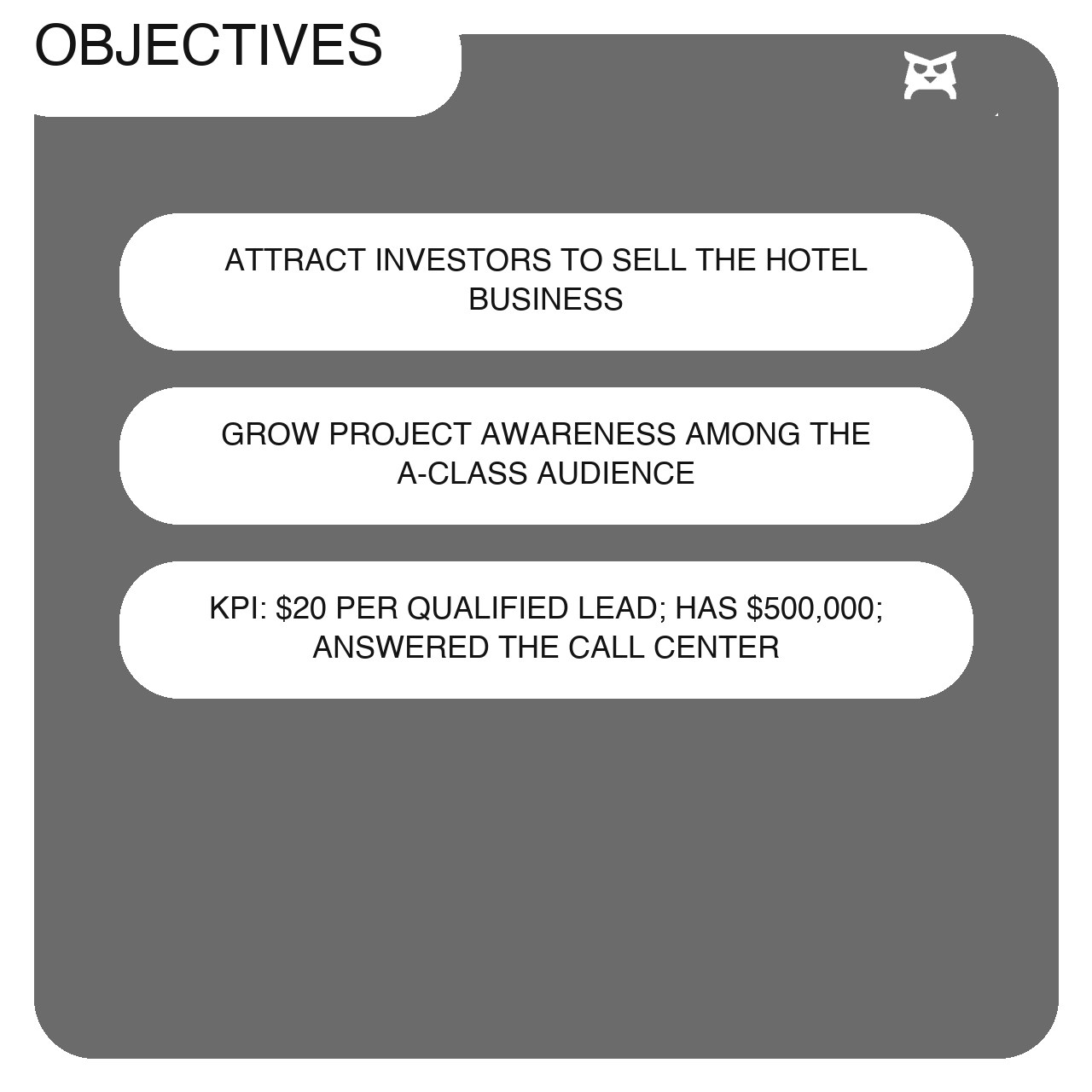
OWL AGENCY faced a set of tasks around lead generation and project awareness:
- Attract investors to buy into the hotel business in Bali.
- Growth in awareness of the HIT project among affluent audiences in Russia, Kazakhstan and a number of other countries.
- Meet the KPI for cost per qualified lead: $20 under fairly strict conditions:
- the investor has capital of at least $500 000,
- confirms an interest in investing,
- answers the call center's call and passes the first stage of qualification.
In essence, the task was not just to "pour in traffic" but to bring in real investors, not people who are "just curious about Bali".
Media mix: the channels we used
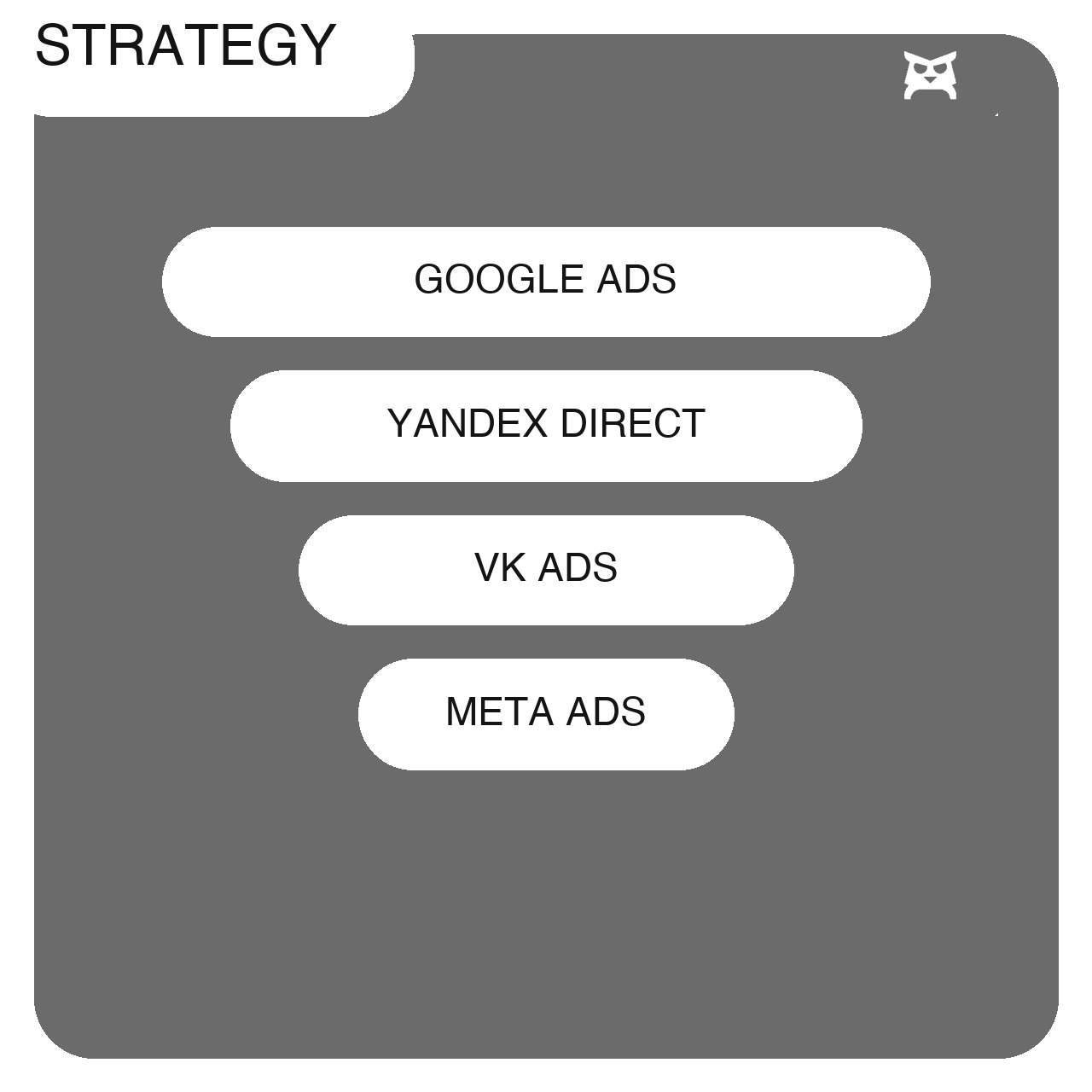
To reach affluent investors without depending on a single source, we built an omnichannel strategy, where each channel played its own role:
- Google Ads : performance on hot and warm demand in 12 countries.
- Yandex Direct : Russia and Kazakhstan, with a focus on key investment queries.
- VK Ads : a brandformance format, from awareness to leads, 10 countries.
- Meta Ads* : an additional source of quality traffic on "real estate and investment" interests in 10 countries.
This stack let us simultaneously:
- collect leads on a considered request (search campaigns),
- build demand and brand awareness among an A-class audience (social media).
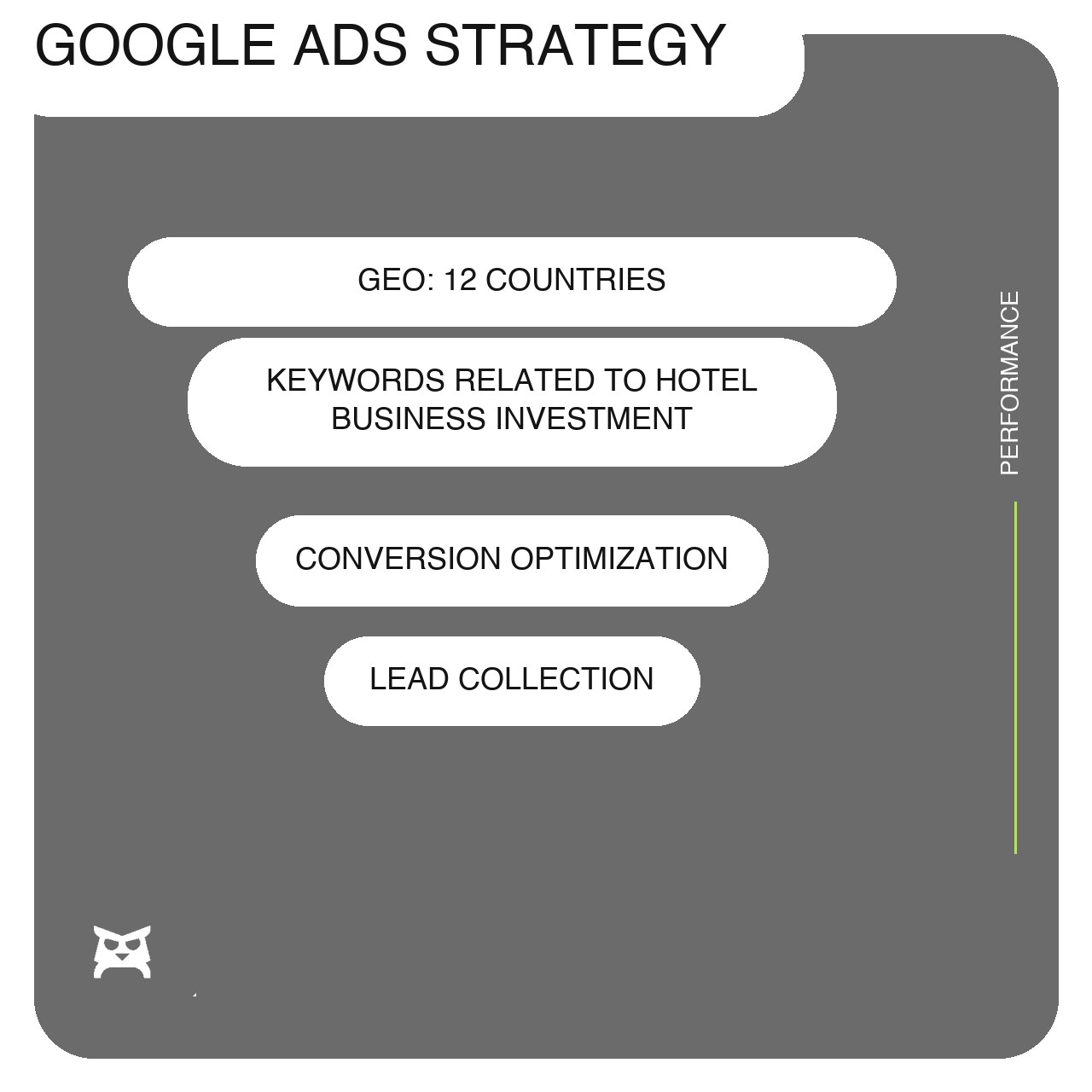
Google Ads strategy: performance in 12 countries
Geography: 12 countries with a high concentration of affluent audiences and an interest in investing: Russia (where available), Kazakhstan, European countries, the US, Asia and others.
1. Keywords and campaign structure
We built keyword set, built on search queries:
- hotel business investment,
- buy a hotel in Bali,
- hotel investment Bali / invest in Bali hotel,
- investment in the hotel business abroad,
- passive income from hotel business, and so on.
Structure:
- campaigns on hot queries (buy, invest, put money into),
- campaigns on informational queries (returns, ROI, real estate investment in Bali),
- brand and near-brand queries.
2. Conversion optimization
- Goal: lead (form / request).
- Strategy: maximum conversions within the set cost target.
- Regular work with search terms: adding "tourist" and non-investment queries as negatives and cutting off irrelevant audiences.
The result: a steady flow of leads with a predictable cost and clear quality.
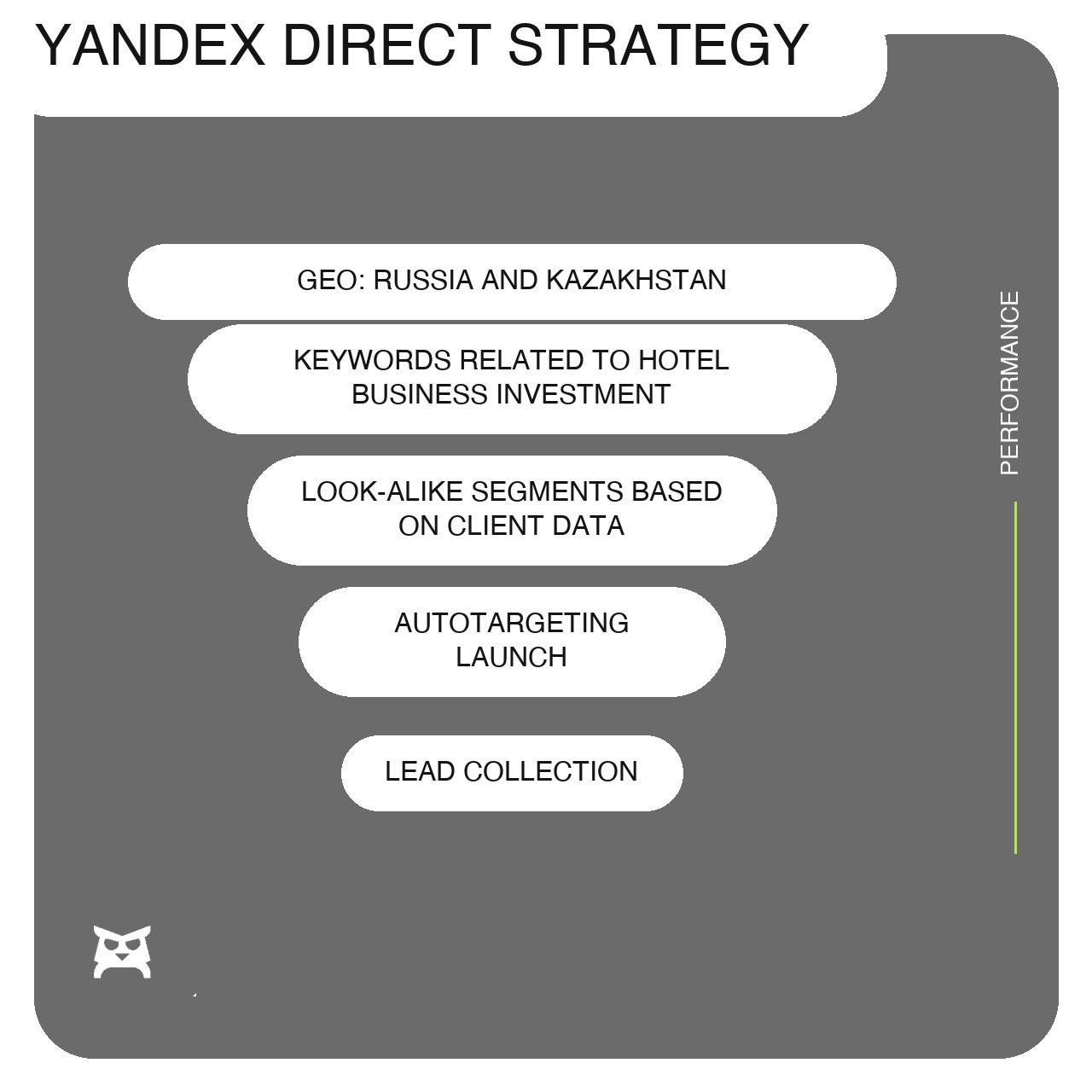
Yandex Direct strategy: Russia and Kazakhstan
Geo: Russia and Kazakhstan are markets where the company traditionally attracts investors and where interest in overseas real estate is strong.
Key features:
- Key search queries related to hotel business investment
- We used both exact and phrase match and carefully cleaned the keyword set of "cheap holiday" and tourist queries.
- Look-alike segments based on the client database
- Using data on current investors and warm leads, we built look-alike segments, which let us expand the audience without losing quality.
- Autotargeting
- We enabled autotargeting on relevant site pages and landing pages to collect extra traffic from algorithms that learn from conversions.
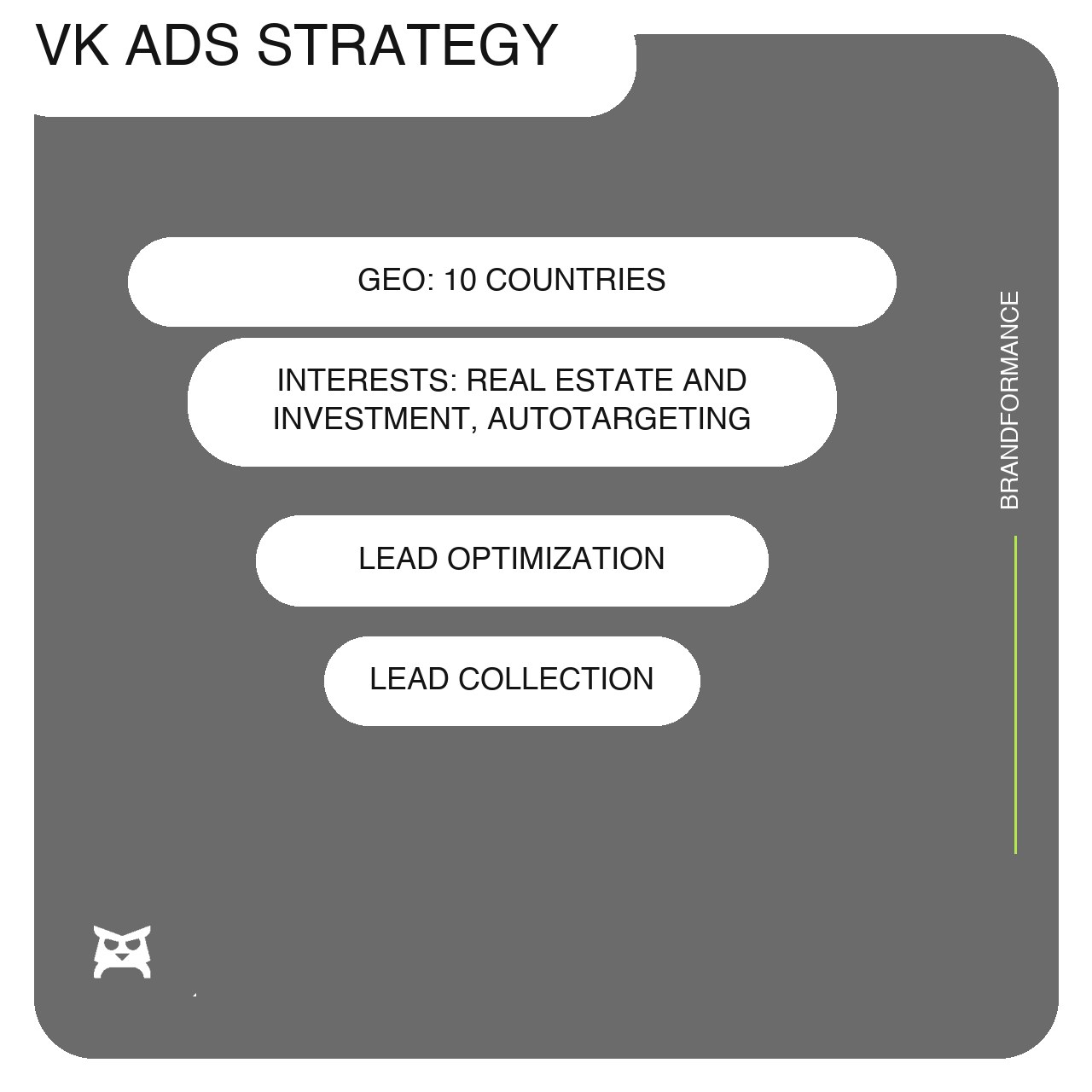
VK Ads strategy: 10 countries, a brandformance approach
Geo: 10 countries where the audience actively uses VK and shows interest in real estate and investments.
Settings:
- interests: real estate, investments, financial literacy,
- additional behavioral segments,
- autotargeting to uncover hidden interests.
Optimization was driven by leads, not clicks: what mattered to us was the number and cost of leads, not "cheap traffic".
VK Ads covered the following tasks:
- expanding the reach and awareness of the HIT brand,
- attracting leads from the CIS and parts of Europe,
- following up on interest through remarketing.
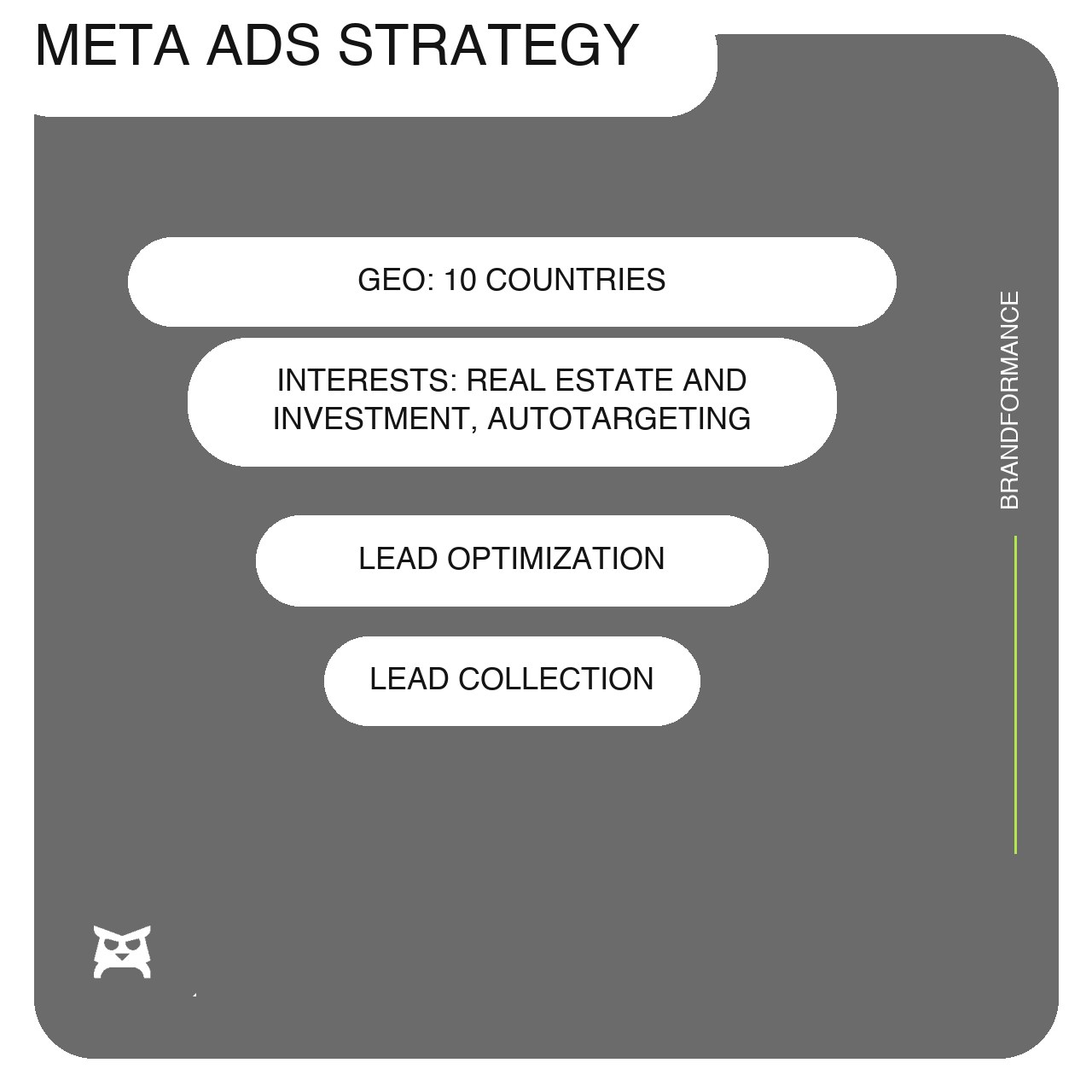
Meta Ads* strategy: global brandformance promotion
*Meta is designated an extremist organization and banned in Russia.
Where legally possible, Meta Ads was used as a strong brandformance channel:
- geo: 10 countries,
- interests real estate, investments, luxury lifestyle,
- autotargeting to find people similar to the converting audience,
- optimization for lead forms and on-site events.
Thanks to the combination of visually strong creatives and precise interests, Meta Ads delivered quality traffic with good engagement.
Creatives: selling returns and peace of mind, not square meters
The core creative idea: investment as a tool for capital protection and passive income, not just "a beautiful hotel in Bali".
In the creatives we emphasized:
- returns from 23% per year in $,
- resale returns of up to 33% per year,
- passive income from $11,000 a year,
- the option of closing the deal remotely,
- format "we run the business, you collect the income".
Visually, a premium style:
- renders and photos of hotel complexes surrounded by greenery and pools,
- clean typography, bold return figures,
- a call to action: "Learn more / Request details".
That way we filtered out "tourists" from the start and attracted people who think in terms of ROI, diversification and capital.


Funnel and lead qualification
Important: the client's goal was not just leads but qualified investors.
1. Basic lead
The user submitted a request:
- through a form on the landing page,
- through a lead form on social media,
- or through forms on third-party platforms.
Average CPL (cost per lead) across all channels: $6.23.
2. Qualified lead
After the request, the client's call center, which:
- Checked for capital of $500,000 or more.
- Clarified a real interest in investing in the hotel business rather than simply buying an apartment "for themselves".
- Recorded readiness for further dialogue and a meeting.
That is how we formed the QCPL (Qualified CPL) : cost per qualified lead.
The campaign closed with a QCPL of $20, which was within the KPI.
3. Lead geography
As a result of the campaigns we got leads from different regions of the world. Ranking geos by the number of leads, we can single out:
- Kazakhstan, Russia, Bali, USA : strong markets where interest in the project was most pronounced.
- Malaysia, China, Japan : promising Asian markets with a high density of affluent audiences.
- European countries and other regions : an additional flow of leads and growing awareness of the HIT brand.
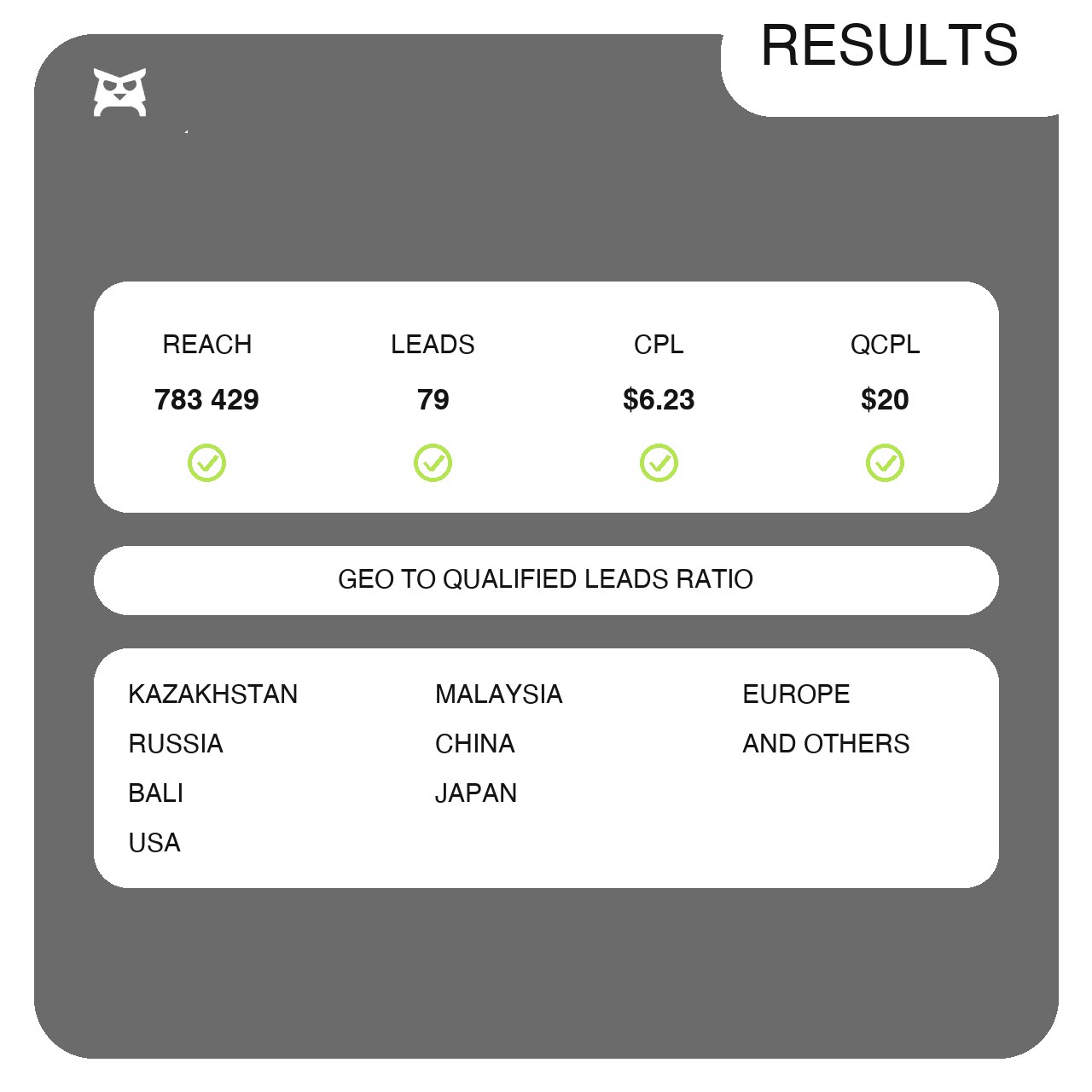
Campaign results
Over the campaign period:
- Reach: 783,429 users
- Leads: 79
- CPL: $6.23
- QCPL (cost per qualified lead): $20
What this means in practice:
- We stayed within the KPI for cost per qualified lead with demanding quality requirements: an investor with capital of $500,000 or more and a confirmed interest.
- We achieved broad reach among a premium audience across ten countries, building lasting awareness of HIT as a reliable Bali investment project.
- We built a scalable lead generation system, which can be expanded through:
- adding new geos,
- raising budgets in the best-performing countries,
- fine-tuning creatives and landing pages based on the analytics collected.
Insights and takeaways
- A strong creative concept + a clear offer (returns, entry ticket, passive income) sharply improve lead quality compared with generic wording like "overseas real estate investment".
- Multi-region and multi-channel are a must for premium investment projects. A single channel or a single country always skews the results, while a broad media mix smooths out the risks and squeezes out the maximum.
- Strict lead qualification through the call center helps you calculate QCPL honestly and understand the real economics of the campaigns instead of living in the illusion of "we have 500 leads, so everything is fine".
- The combination of Google Ads + Yandex Direct + VK + Meta Ads* proved to be a robust stack for promoting overseas real estate and the hotel business : from the first touch to a request and a conversation with a manager.
FAQ on promoting investment projects and overseas real estate
1. Can this strategy be repeated for other countries, not just Bali?
Yes. The approach described in the HIT case scales to any country and property type: from aparthotels in Dubai to villas in Spain or office centers in Europe. The creatives, keywords and geos change, but the funnel logic stays the same.
2. Which channels work best for attracting real estate investors?
The optimal mix is search engines (Google Ads, Yandex Direct) for hot demand + social media (VK, Meta Ads*) for reach, follow-up and working with audiences that are still only considering an investment.
3. How do you tell that a lead is a real "investor" and not just a curious person?
We needed clear qualification criteria: minimum capital, readiness for a call or meeting, and a specific interest in investing rather than just "living in Bali". These criteria are agreed with the client and built into the call center scripts.
4. What CPL and QCPL can be considered normal for investment projects?
It all depends on the ticket size and product margin. In this case we reached CPL $6.23 and QCPL $20 for a product with an entry ticket from $182,000 and an audience with capital from $500,000. For other projects the metrics will differ, but the calculation method stays the same.
5. How long does it take to test hypotheses and reach a stable cost per lead?
Usually, the first valid result it takes 1 to 2 months: during that time we test hypotheses on creatives, geos, segments and formats, then build a stable media plan and scale the best combinations.
Similar projects:
Semya Group
ATOMM Design Bureau